How this began
A few weeks ago, I went looking for my father's family line for the first time. With the help of AI, I dived into old archives — birth certificates, marriage registers, population records. That resulted in a number of spectacular discoveries — I found the payment receipt of my grandmother's great-grandfather, who had apparently served under Wellington at the Battle of Waterloo. But above all, I learned new skills: how to work with archives in a completely different way.
Background (weekly blog posts, in Dutch):
Without that, I could not have done this. Because then I went looking for my grandmother's wartime past.
My grandmother walked the Women's March
My grandmother, Albertien Lunshof-Lunshof, walked on 11 April 1945 in the Women's March: 116 female political prisoners who left Camp Westerbork on foot, guarded by nearly twice as many German soldiers as there were prisoners. From her eyewitness account, which is held in the archive of the Westerbork Memorial Centre, I knew that in those final days of the war she was constantly dealing with the notorious camp commandant Gemmeker. On 14 April they were liberated near Grijpskerk by Canadian troops. My grandmother was number 104. The march is known as the Vrouwenmars (Women's March).
Producer Carla Wolbers, director Ted Alkemade and researcher Ika van Doorn of Slate51 made the documentary De Vrouwenmars (The Women's March) about this march, which premiered in cinemas on 11 April 2026 — exactly 81 years after the day the march began.
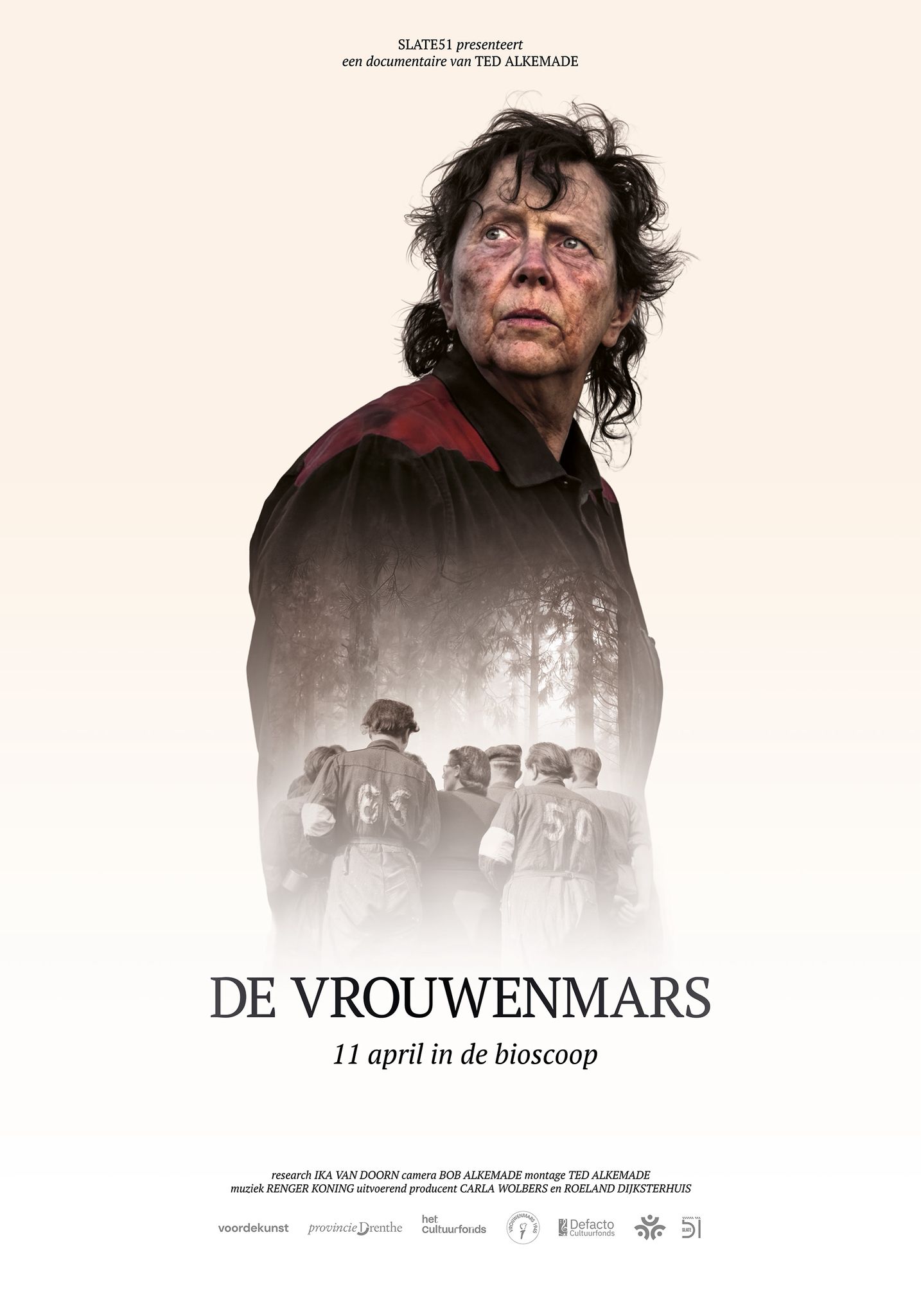
vrouwenmars1945.nl The Women's March — the documentary The list of 116 women

Grijpskerk, 18 April 1945 — the women of the march with Prince Bernhard. The woman in the back row, fifth to the right of Bernhard, is likely my grandmother. Photo: Willem van de Poll, National Archives.
Her youngest sister, G.H. Lunshof — my aunt Gé, who died far too young of leukaemia — code name "Tiny", lived above my grandmother at Celebesstraat 22a in Groningen. From the archive cards I could deduce that many of their fellow resistance fighters lived next door or around the corner — in the context of those times, that makes perfect sense.
Aunt Gé was a member of the GDN (Secret Service of the Netherlands) and the ID (Intelligence Service), and at the age of twenty-one was secretary to Willem Schoemaker, then head of the GDN and one of the most important resistance coordinators in the Netherlands. In the autumn of 1944, she was sent as a spy on a mission to the heart of Nazi Germany — Berlin. Family lore has it that she escaped Germany on the roof of a train. She received the Bronze Lion from Prince Bernhard — the second-highest military decoration of the Netherlands, comparable to the British Military Cross or the American Distinguished Service Cross.
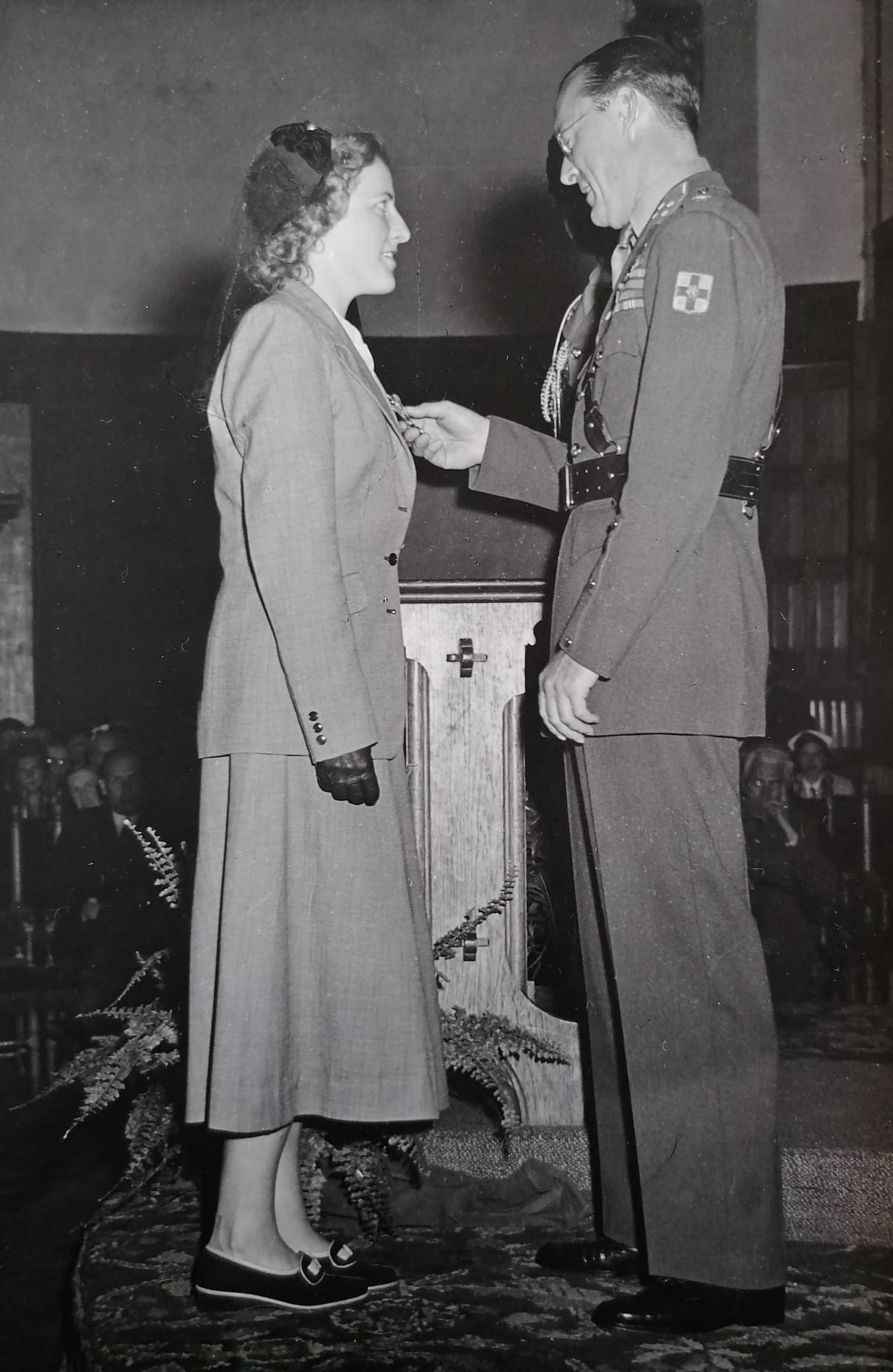
G.H. Lunshof receives the Bronze Lion from Prince Bernhard
Their archive cards in the Groningen Archives:
Albert Lunshof — minr 1153854 G.H. Lunshof — minr 1153857
The subordinate clause that changed everything
When I looked up the card of my grandfather Albert, it read:
My grandmother — who marched for four days through the cold, guarded by nearly twice as many German soldiers as there were prisoners — has no resistance card of her own. She exists in the archive only as a subordinate clause on her husband's card.
That struck a nerve. I started looking: how many women have their own card? How many appear only as a subordinate clause? And if this archive has this blind spot — what other blind spots does it have?
I wanted to map it out.
But it got completely out of hand.
What happened
In the weeks before, I had built a pipeline for another archive project that uses AI to decipher and structure handwriting. In the night of 5 to 6 April 2026, I reused that pipeline on 3,150 handwritten resistance cards from the Groningen Archives. In 100 minutes and for fifty euros in API costs (a negligible amount given the result), they were converted into structured data: name, code name, date of birth, profession, resistance group, what they did, who they knew, whether they were arrested, and whether they survived.
The cards had been digitised for over twenty years — they had been painstakingly photographed and catalogued with metadata. But they had never been informatised: the contents were not searchable or linkable, nor countable (which is useful for analysis). You could look up a card if you already knew the name. But you could not ask: who was arrested on 13 November 1943? or how many cards mention betrayal?
Now you can.
This produced 3,034 story cards, cross-checked against 6 online sources, with 489 strong external confirmations. To be clear, these are not 3,034 answers but 3,034 puzzles to be solved — research questions. Puzzle pieces that were largely invisible for eighty years, hidden across a multitude of archive index cards.
The transcription ran overnight while I slept — the next morning 3,150 structured cards were ready. The verification is not yet complete and will take months. That is precisely the point: the speed makes it possible to reveal connections that would be unfeasible to find manually. The rigour must follow — and help with that is welcome.
Why this site exists in English
This site exists because descendants of these resistance fighters now live all over the world. If your family came from Groningen and you have pieces of this puzzle — a document, a photo, a memory — we want to hear from you.
The resistance cards cover the entire province of Groningen and mention thousands of names: fighters, couriers, people in hiding, traitors, and those who were deported and never returned. Many of the families involved emigrated after the war — to Canada, the United States, Australia, South Africa. If your surname appears in this archive, there may be a story here that connects to yours.